
How to Improve Quote to Bind Performance in P&C Insurance

Every quote begins with an opportunity.
An agent has a risk to place. An underwriter wants to evaluate the risk quickly and accurately. The business wants to respond while the opportunity is still active. The policy team needs clean information when the account is ready to move forward. Everyone is trying to reach the same outcome, but the process can slow down when work is scattered across submissions, emails, documents, systems, approvals, and manual follow-ups.
That is why quote-to-bind performance matters. It is not just about producing a quote faster. It is about creating a clearer, more reliable path from submission to bind-ready business.
For P&C insurers, MGAs, and program administrators, improving quote to bind performance depends on stronger submission quality, better data access, fewer manual handoffs, clearer workflow visibility, and smoother movement from quote approval to bind readiness.
Modern policy platforms such as DigitalEdge Policy can help insurers improve these areas by connecting submission intake, underwriting workflow, rating, quote generation, integrations, and downstream policy processing in a more coordinated operating environment.
Quick Answer
Quote-to-bind performance is not only an underwriting metric. It is a growth, distribution, and operating-capacity signal. If quote volume is rising but bind ratio is not improving, the issue may be workflow friction, appetite fit, agent experience, or follow-through after quote approval.
Insurers can improve quote-to-bind performance by improving submission quality, reducing manual intake, eliminating unnecessary handoffs, integrating third-party data earlier, improving workflow visibility, and creating a smoother path from quote approval to bind readiness. The goal is not just faster quoting. It is faster, cleaner, more consistent movement from submission to bound business.
What Quote-to-Bind Performance Means
Quote-to-bind performance describes how effectively an insurance organization moves from a submission or quote request to a bind-ready or bound policy. It includes speed, accuracy, conversion, underwriting responsiveness, and operational reliability.
A strong quote-to-bind process does not simply generate quotes quickly. It helps underwriters, agents, and operations teams move through submission review, rating, quoting, approval, and bind readiness with fewer delays and less rework.
Depending on the operating model, bind readiness may involve underwriting approval, agent action, payment, required documents, forms, or downstream policy issuance steps.
In practical terms, quote-to-bind performance connects multiple parts of the insurance operation: submission intake, underwriting, rating, quoting, agent communication, data access, and downstream policy processing.
Why Quote-to-Bind Is Not Just Speed
Speed matters, but quote-to-bind performance should not be treated as a race to produce the fastest possible quote.
A fast quote based on incomplete data can create rework. A fast quote without underwriting confidence can increase risk. A fast quote that does not lead smoothly to bind readiness can still frustrate agents and operations teams.
The better question is not, “How do we quote faster at any cost?” It is, “How do we remove avoidable friction so good opportunities can move forward with confidence?”
Better quote-to-bind performance means better flow. Submissions should arrive with the right information. Risk data should be available earlier. Underwriting rules and workflows should guide the process. Agents should receive timely responses. Operations teams should be able to see where work is moving, where it is stuck, and what needs attention.
The real goal is not speed alone. It is a quote-to-bind process that is faster, more reliable, more consistent, and easier to scale.
PRO TIP
Insurers can improve quote to bind performance by improving submission quality, reducing manual intake, eliminating unnecessary handoffs, integrating third-party data earlier, improving workflow visibility, and creating a smoother path from quote approval to bind readiness. The goal is not just faster quoting. It is faster, cleaner, more consistent movement from submission to bound business.
Why Quote-to-Bind Performance Matters
Quote-to-bind performance matters because agents and brokers often judge a market by how clearly and quickly it responds. A slow or unclear process creates doubt. Repeated follow-up creates frustration. Long waits can cause good opportunities to move elsewhere.
For underwriting teams, slow quote-to-bind performance creates a different problem. Underwriters spend time chasing missing data, re-entering information, checking status, or moving work between systems instead of focusing on risk selection and decision quality.
For leadership teams, the issue becomes even bigger. A slow quote-to-bind process limits growth capacity. More submissions may create more opportunity, but only if the organization can manage that volume without adding manual effort at the same pace.
Improving quote-to-bind performance can help insurers respond faster, improve agent confidence, increase bind conversion, and support growth without proportional increases in administrative workload.
Why Quote-to-Bind Ratio Is a Key Marker
Quote-to-bind ratio is one of the clearest business markers for quote-to-bind performance because it shows how many quoted opportunities turn into bound policies. A low ratio may point to pricing, appetite, submission quality, response time, agent experience, or operational follow-through issues.
The ratio should not be viewed in isolation. A carrier may quote quickly but still lose business if agents lack confidence, if revisions take too long, or if the path from quote approval to bind readiness is unclear. Used alongside turnaround time, submission quality, and bind readiness, quote-to-bind ratio helps leaders see whether the quoting process is simply active or actually converting opportunity into written business.
A higher quote-to-bind ratio is not automatically better if it comes at the expense of appetite discipline, pricing adequacy, or risk selection.
What Slows Quote-to-Bind Performance
Quote-to-bind delays usually come from operational friction, not one isolated broken step. The process often slows down when teams depend on manual intake, fragmented systems, unclear routing, or incomplete information. Common causes include:
- Incomplete or low-quality submissions
- Manual data entry and duplicate data capture
- Fragmented rating, underwriting, and policy systems
- Repeated handoffs between teams
- Slow referrals, approvals, or exception handling
- Limited visibility into quote status and blockers
- Delayed access to third-party risk data
- Quote revisions that require too much manual effort
- Final-stage friction between quote approval and bind readiness
These issues may look small individually. Together, they create a slow and inconsistent operating model. Underwriters lose time. Agents wait longer. Operations leaders struggle to see where work is stuck.
The result is a quote-to-bind process that becomes harder to manage as volume increases. The organization may still be doing the right underwriting work, but the environment around that work makes progress slower than it needs to be.
How Insurers Can Improve Quote-to-Bind Performance
Improving quote-to-bind performance starts with understanding where work slows down and which steps create the most rework. The strongest improvements usually come from several operating levers working together.
First, insurers should improve submission quality before underwriting begins. A cleaner submission gives the team a better starting point. It reduces back-and-forth, shortens review time, and helps underwriters focus on risk decisions instead of missing information.
Submission quality is not only about completeness. It also includes appetite fit, eligibility, risk characteristics, and whether the opportunity should move forward at all.
Second, intake and data capture should be automated wherever possible. Manual entry slows teams down and increases the chance of errors. Automated intake helps move submission data into the workflow faster and more consistently.
Third, rules and workflow routing should reduce unnecessary handoffs. Submissions, referrals, exceptions, and approvals should move through defined paths instead of relying on email, spreadsheets, or informal follow-up.
Fourth, teams need better visibility into quote status and blockers. Operations leaders should be able to see where quotes are waiting, which steps are slowing the process, and where workloads are building.
Fifth, third-party data should be available earlier in the process. When underwriters can access relevant risk, property, vehicle, sanctions, or exposure data at the point of decision, they can reduce manual research and make faster, more confident decisions.
Finally, the transition from quote approval to bind readiness should be designed intentionally. A quote that cannot move smoothly toward bind still leaves friction in the system.
What Modern Policy Platforms Change
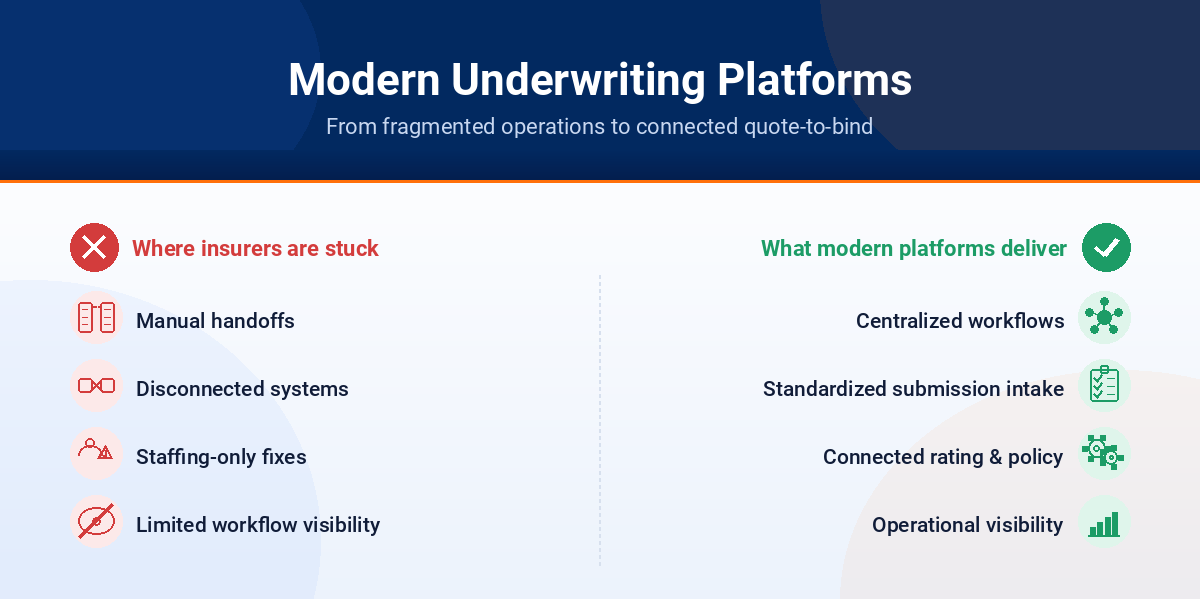
Modern policy platforms help insurers move beyond disconnected steps and manual coordination. Instead of treating submission intake, rating, underwriting workflow, quote generation, rules, forms, integrations, and downstream policy processing as separate activities, a modern platform can bring them into a more connected operating environment.
This changes the experience for multiple users.
For underwriters, it can reduce swivel-chair work, duplicate entry, and manual follow-up. The work becomes easier to see, prioritize, and move forward.
For agents and brokers, it can improve response speed, status clarity, and the overall ease of doing business. Instead of waiting through unclear process gaps, distribution partners can experience a more predictable path from submission to quote and from quote to bind readiness.
For operations leaders, it can create better visibility into quote flow, bottlenecks, workload pressure, and performance. That makes it easier to see whether delays are caused by submission quality, underwriting review, referrals, missing data, quote revisions, or downstream handoff issues.
Modern policy platforms can also support stronger consistency. Rules, workflows, forms, data integrations, and quote generation can work together so teams are not relying on fragmented tools or informal process knowledge.
The result is not simply a faster system. It is a better operating model for quote-to-bind execution.
Proof That Quote-to-Bind Can Improve
Quote-to-bind improvement is not theoretical. The right operating changes can produce measurable business outcomes.
SGIC increased its overall bind ratio from 6% to 40%, with some individual agents moving from single-digit bind ratios to 40-90%.
Read – How One Carrier Increased Quote-to-Bind Ratios from 6% to 40%
Treaty Oak quoted 72% of its prior year’s total volume in only 3 months on the platform, without adding headcount.
Read – How An MGA Achieved 72% of Its Prior Year’s Volume in Just 3 Months Without Additional Headcount
These outcomes are strongest when platform capability is paired with cleaner workflows, clear user adoption, and disciplined operating change.
These examples show why quote-to-bind performance should be treated as a growth and operations issue. Better workflows, better visibility, and better platform support can change how much business teams can handle and how effectively they convert opportunity into bound policies.
How to Start Improving Quote-to-Bind Performance
A quote-to-bind improvement effort should begin with a practical review of the current workflow.
Start by identifying where quotes stall. Review whether submissions arrive with complete information. Measure how often teams re-enter data, request missing details, or move work manually between systems. Look for referral, approval, and exception steps that create repeated delays.
Next, connect these issues to business outcomes. Which delays affect agent response time? Which ones hurt bind conversion? Which manual steps limit underwriting capacity? Which gaps create downstream policy processing friction?
The strongest roadmap will focus on measurable operating improvements, not generic modernization. Prioritize changes that reduce rework, improve response time, support underwriter confidence, and create a clearer path from submission to bind.
Quote-to-bind performance improves when teams stop treating friction as normal and start managing it as an operating problem that can be designed out of the workflow.
Explore DigitalEdge Policy
AI-powered platform to streamline submissions, speed underwriting cycle times, and elevate post-sales servicing of P&C insurance policies.
Frequently Asked Questions
What is quote-to-bind performance in insurance?
Quote-to-bind performance measures how effectively an insurer, MGA, or program administrator moves from a quote request or submission to bind-ready or bound business. It includes speed, submission quality, underwriting responsiveness, quote accuracy, workflow reliability, and the ability to convert opportunities into policies.
Why does quote-to-bind speed matter?
Quote-to-bind speed matters because agents and brokers often expect timely responses. Slow quoting can reduce confidence, increase follow-up, and cause business opportunities to move elsewhere. However, speed alone is not enough. The process also needs quality data, underwriting confidence, and a clear path to bind readiness.
What causes quote-to-bind delays?
Quote-to-bind delays often come from incomplete submissions, manual data entry, fragmented systems, unclear referral paths, slow approvals, limited workflow visibility, delayed access to third-party data, and final-stage bind readiness gaps. These issues create rework and make it harder for teams to scale as submission volume increases.
How can technology improve quote-to-bind performance?
Technology can improve quote-to-bind performance by automating intake, reducing duplicate data entry, routing work through defined workflows, integrating third-party data, improving visibility into quote status, supporting rating and quote generation, and helping teams move more smoothly from quote approval to bind readiness.


